Printed samples are teaching props
This page owns a short list of printed samples: 078-05-1120, 219-09-9999, 123-45-6789, and 987-65-4320 through 987-65-4329. It also owns SSA’s advertiser instruction to display 000-00-0000 instead of a lookalike card. Those strings show up in wallets, pamphlets, forms, tutorials, and ads because someone needed nine digits that looked like a Social Security Number.
They are famous as teaching props. They are not a people-search result, a death-index hit, or a reason to reconstruct a stranger’s record. A sample flag on this site means we recognized a well-known public string. It does not mean we identified a current holder.
If you want to see the labels, paste the samples into the SSN Validator. Use those strings, not a coworker’s card, when you are only testing the tools. Habits for a real number belong in How to keep a Social Security Number private.
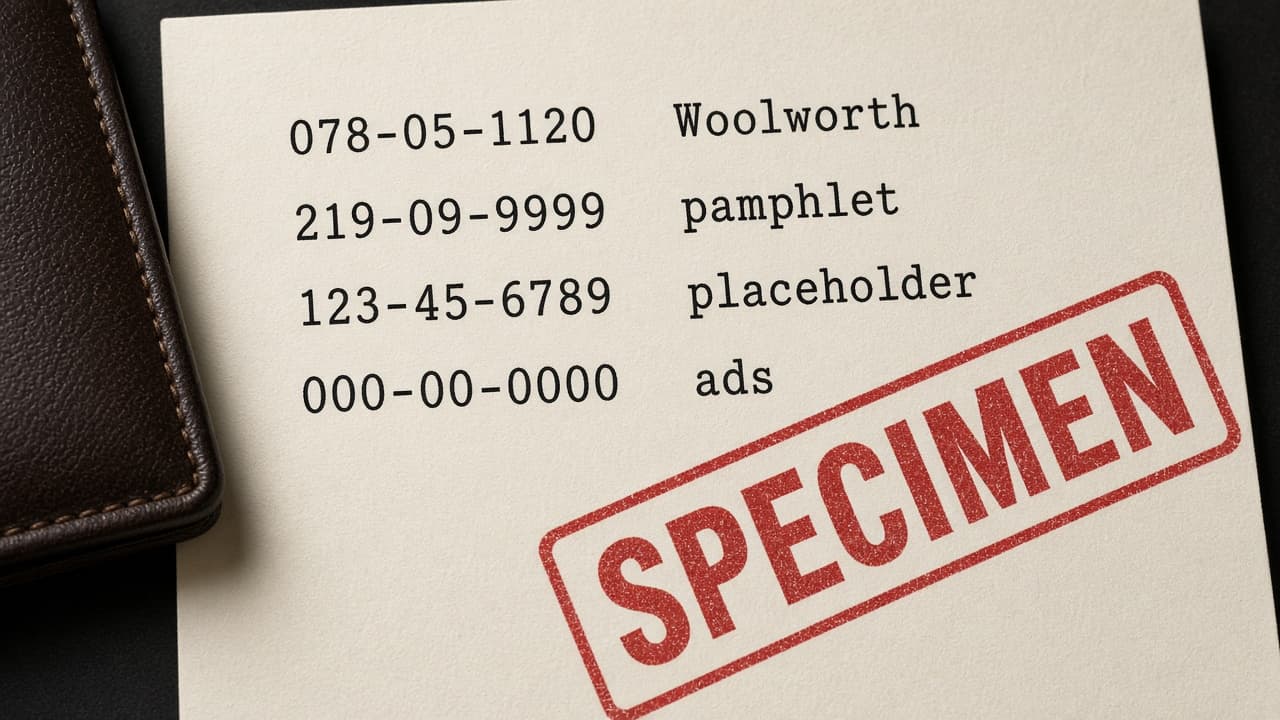
078-05-1120 and the Woolworth wallet insert
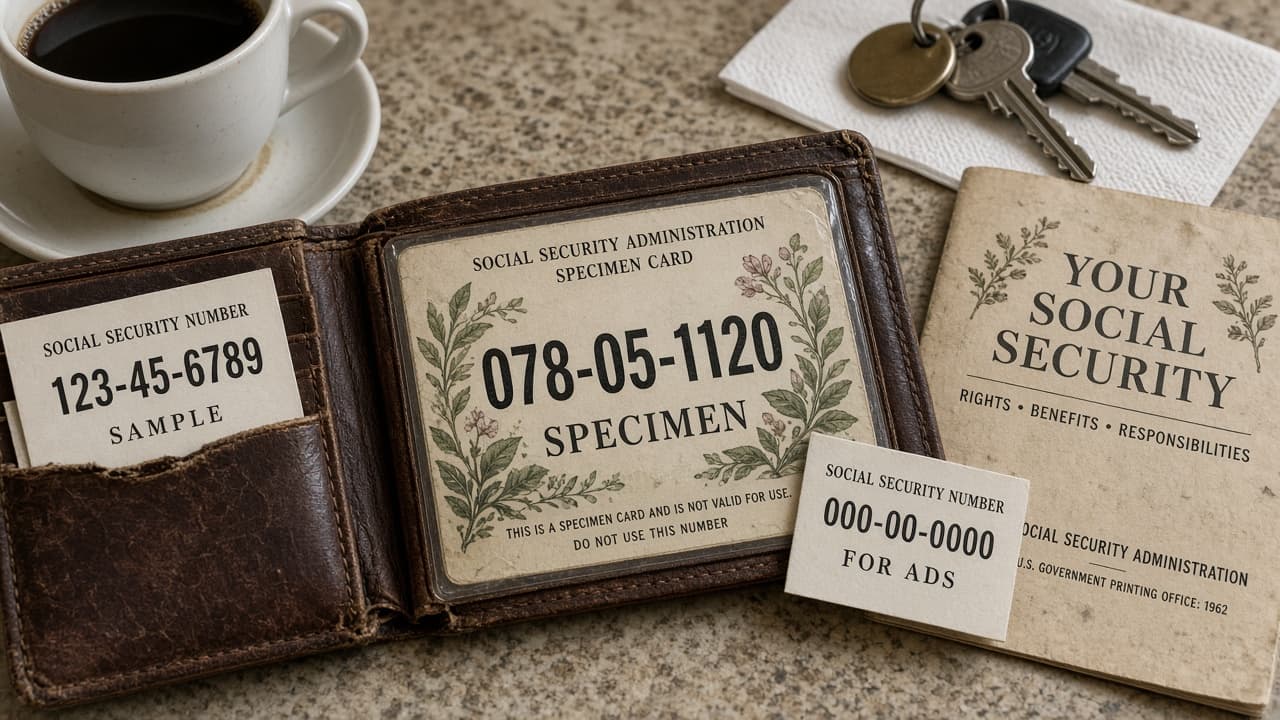
In 1938 a Lockport, New York wallet maker, the E. H. Ferree company, wanted to show that a Social Security card would fit in its product. Each wallet shipped with a display insert. SSA’s history of misused numbers says the company used the actual number of a company secretary: 078-05-1120. Woolworth stores and other department stores sold the wallet nationwide.
The insert was only half the size of a real card, printed in red, and marked specimen. That was not enough. Purchasers treated the printed number as their own. SSA says the peak year was 1943, when 5,755 people were using it, and that more than 40,000 people reported the number over time. As late as 1977, a dozen people were still using the number “issued by Woolworth.”
SSA voided 078-05-1120 and publicized that it was incorrect to use it. The secretary received a new number. The printed string stayed famous because it kept turning up on wage reports. Area 078 sits in the historic New York allocation, 050–134. That chart match is history. It is not a current address.
We flag 078-05-1120 as a public sample. We do not treat the flag as a biography, and we do not use it as a reason to look anyone up.
219-09-9999 on the 1940 pamphlet cover
In 1940 the Social Security Board published a pamphlet explaining the new program. The cover showed a facsimile card that used 219-09-9999. SSA’s history page calls the digits a made-up number. They were an illustration, not an issuance.
People later treated the illustration as their own number. SSA’s history page tells of a later field-office visit in which someone produced the 1940 pamphlet as proof that 219-09-9999 was theirs. The lesson is about a printed cover being mistaken for a card. It is not a person to identify.
Area 219 sits in the historic Maryland allocation, 212–220. Our checker can still show that chart note. We label the pamphlet digits as a sample first. A Maryland band does not turn a cover drawing into an issued card.
123-45-6789 is a common unofficial demo
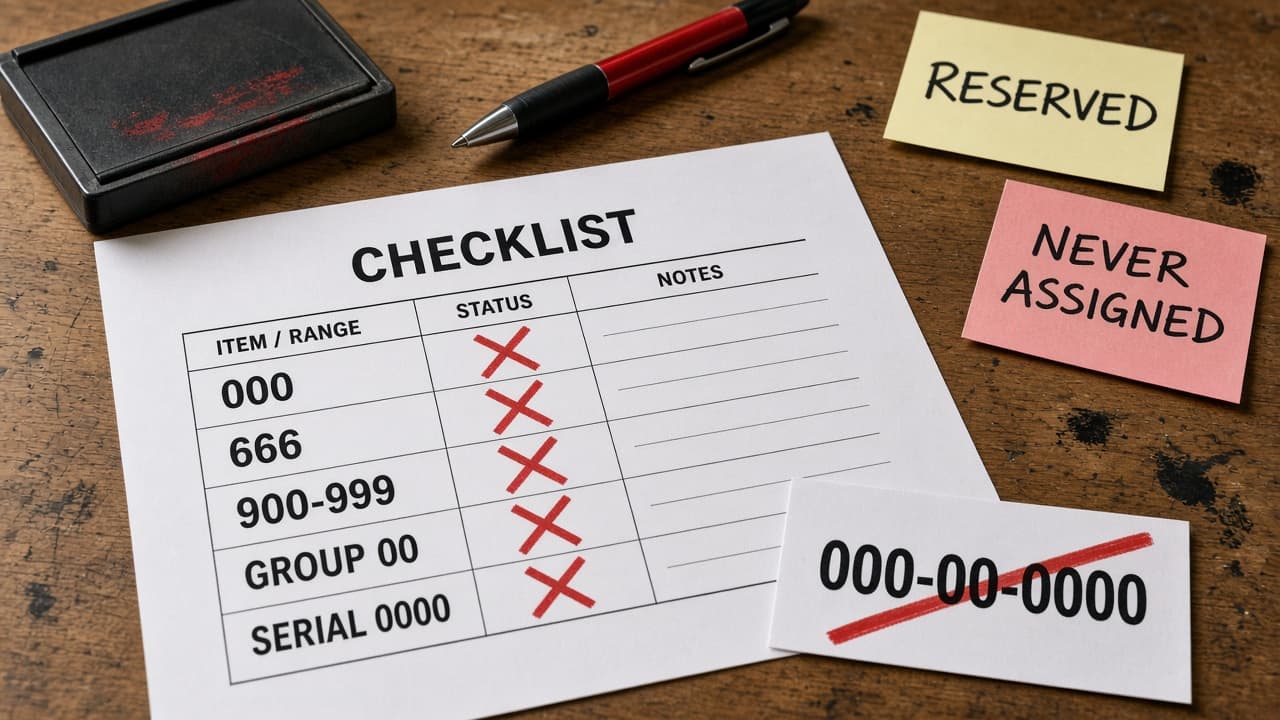
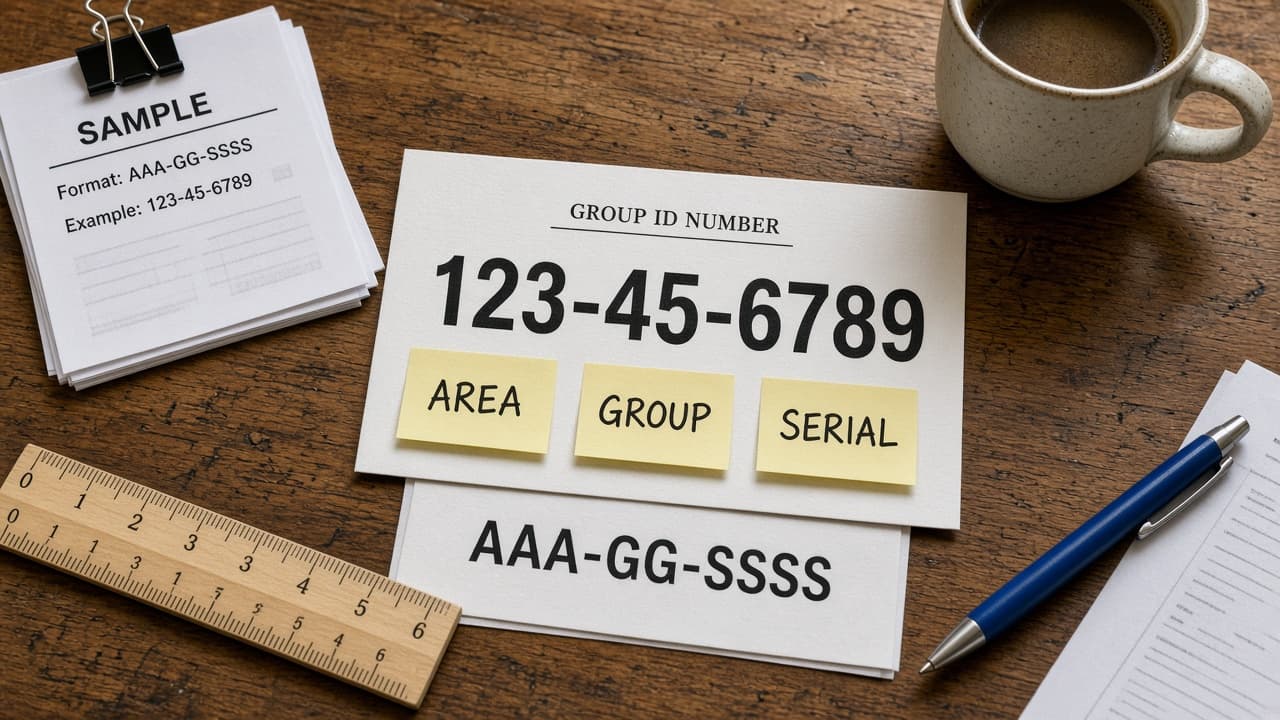
123-45-6789 is a common unofficial demo on screenshots and competitor sites. SSA does not reserve it. Official government forms usually print XXX-XX-XXXX. The string looks like a Social Security Number because it has three, two, and four digits. A naive format test can look clean: the area is not 000 or 666, the group is not 00, and the serial is not 0000.
The pattern is structurally possible. SSA’s published reservation rules do not forbid it. That is exactly why we still label it a sample. A demo value should not be read as a “verified issued” result, and it should not be treated as a person.
If you are filling a tutorial, a bug report, or a classroom slide, this is a string people already expect. We cannot tell from public rules whether SSA ever assigned it. Our job is to say both things: possible under the print rules, famous as a demo. Paste it into the SSN Validator if you want to see that label.
987-65-4320 through 987-65-4329
These ten numbers, 987-65-4320 through 987-65-4329, show up on unofficial example lists. SSA does not assign areas 900–999 as Social Security Numbers, so they cannot be Social Security Numbers. SSA’s current instruction for ads is 000-00-0000, not this band. Impossible SSN patterns is the place for that reserved-band rule.
Group 65 sits in a published ITIN range. That is a format tell, not an IRS confirmation, and it is not why we list this band. We list it because the ten strings are public samples.
The SSN Validator flags the whole 987-65-432x band as a well-known sample before it discusses ITIN shape. The summary still says the area cannot be an SSN. Do not read that as “we found an ITIN holder.” It is a printed example in a band that SSA never uses for Social Security Numbers.
SSA tells advertisers to display 000-00-0000
Current SSA staff guidance, in POMS RM 10201.020, tells people who want to show a nine-digit number in an ad, article, or film to display 000-00-0000. The point is to avoid printing someone’s valid number and causing the number holder problems. If the requester will not use all zeros, SSA says any combination that begins with 000 is the fallback, because any other combination could be a valid SSN.
000-00-0000 is not a lookalike. Area 000, group 00, and serial 0000 are reserved values SSA never assigns. Our checker therefore classifies 000-00-0000 as impossible, not as a famous sample. That is the feature. Advertisers get a string that cannot belong to a person.
The same instruction is why a movie prop or a magazine facsimile should not invent a “realistic” card number. The Woolworth insert and the 1940 pamphlet are the case studies. SSA’s history page records more than a dozen later facsimile mix-ups. This page does not collect those extra strings.
Section 1140 of the Social Security Act also limits use of SSA symbols and a reasonable facsimile of the card in a manner that conveys a false impression of government approval. Displaying 000-00-0000 is the number advice. It is not a license to dress a product as an official card.
How SSN Validator labels these strings
The SSN Validator looks for an exact match on 078-05-1120, 219-09-9999, and 123-45-6789, and for the ten-number 987-65-432x band. A hit is classified as a well-known sample. The on-screen title is “Well-known sample number.” The short label is “Sample.” The summary explains which printed source we recognized and then says the check does not identify a current holder.
Historic area notes can still appear. 078 maps to the old New York band. 219 maps to the old Maryland band. Those notes are chart lookups. They do not turn a sample into a hometown, and they do not mean we found a person in that state.
000-00-0000 does not take the sample path. It fails the reserved-value rules first, so you will see impossible. That matches SSA’s reason for recommending it. If you need the difference between reserved patterns and folklore, use the reserved-pattern guide.
Nothing in that result is a verification. We do not query SSA, match a name, or search a death index. Possible, sample, and impossible are format labels. They are not biographies.
A sample flag is not a biography
A sample flag answers one question: is this a well-known public string we chose to label? It does not answer who held the number, whether anyone still uses it, or what a wallet insert once meant for a private life. We will not write that life here.
SSA’s history page is the official account of how 078-05-1120 and 219-09-9999 were printed and later misused. We repeat the printed-object facts because they explain why the strings are famous. We do not turn the flag into a profile, a relatives list, or a “where are they now.”
If you came here hoping a checker would identify a stranger, stop. Do not type someone else’s number into this site. Use the samples on this page. Privacy habits for a real card are in the privacy guide.
Sample, reserved, and possible are different results
Reserved values are patterns SSA says it never assigns: area 000, area 666, areas 900–999, group 00, and serial 0000. Those belong on the reserved-pattern guide. A sample can sit inside a reserved band, as 987-65-4320 does, or it can be structurally possible, as 123-45-6789 is. The sample label is about fame in print. The reserved label is about published rules.
A possible result means the digits follow those rules and are not on our short sample list. It does not mean SSA assigned the number. It does not mean a person exists. Only official SSA channels can match a name to a number.
Mixing those three labels is how people talk themselves into a people search. A sample is not “the original owner.” A reserved pattern is not “this ITIN belongs to someone we found.” A possible result is not “verified.” Keep the words boring and the actions small.
Why lookalike numbers keep circulating
Forms need a placeholder. Designers need a card that fits a screenshot. Teachers need nine digits that will not surprise a class. The cheapest way to get those digits is to copy a string that already looks right. That is how 123-45-6789 and the 987-65-432x band stay alive in 2026.
The older printed cases had a worse failure mode. A wallet insert and a pamphlet cover were physical objects. People kept them. Some used them on jobs. SSA’s history page is blunt: specimen stamps and half-size red cards did not stop the Woolworth number from being used by thousands of people.
If you publish a screenshot, a novel, or an ad, display 000-00-0000. If you are testing this site, use the samples on this page. If you are protecting a real number, do not put it in the screenshot at all. Crop the digits. More of that habit work is in the privacy guide.
What we will not add
We will not maintain a leaked-number list, a deceased-person index, or a generator that mints plausible unused numbers. Those products exist elsewhere. They are not this project.
We will not expand this page into a catalog of every facsimile SSA has ever mentioned. The owned list is the Woolworth insert, the 1940 pamphlet cover, the unofficial 123-45-6789 demo, the 987-65-432x examples, and the 000-00-0000 advertiser instruction. Extra “famous” strings invite the same misuse the history page is warning about.
If you need a format check, use the SSN Validator. If you need reserved-value rules, use the reserved-pattern guide. If a real number was exposed, start the privacy steps. None of those pages will look someone up for you.
Frequently Asked Questions
Is 123-45-6789 a valid Social Security Number?
The digits follow the print shape, so a naive format test can look clean. SSA does not reserve 123-45-6789. The pattern is structurally possible. We still treat it as a well-known sample so a demo value is not read as an issued card.
Why is 078-05-1120 famous?
It was printed in Woolworth wallets as a specimen insert. SSA later voided it after thousands of people used the printed number. We label it a sample. The flag is not a biography.
Why is 219-09-9999 a sample?
SSA’s 1940 pamphlet used those digits on a facsimile card on the cover. People later treated the illustration as their own number. We label the pamphlet digits as a sample first.
Why are 987-65-4320 through 987-65-4329 not Social Security Numbers?
Area 987 is in the 900 series. SSA does not assign areas 900–999 as Social Security Numbers. The ten strings are still public samples, which is why the checker labels the whole band that way.
Should advertisers use a lookalike SSN?
No. SSA tells advertisers to display 000-00-0000 rather than a lookalike card number. The 987-65-432x band cannot be an SSN anyway because it starts with 9.
Why does 000-00-0000 show as impossible, not as a sample?
Area 000, group 00, and serial 0000 are reserved. SSA recommends that string for ads because it cannot be someone’s valid number. Our checker applies the reservation rules first.
Does a sample flag identify the original cardholder?
No. A sample flag means we recognized a well-known public string. It does not identify a current holder, and we do not treat the flag as a biography.
Do you list leaked or deceased-person numbers?
No. We do not maintain a leaked-number list, a death index, or a generator.