What this site calls impossible
A Social Security Number is nine digits. Plenty of nine-digit strings will never appear on a card because the Social Security Administration reserved the slot. Plenty of other strings look fine on paper and still were never assigned to anyone. Those are different facts. We only use the word impossible when SSA’s published composition rules say the pattern is never assigned.
SSA’s own invalid-SSN policy (POMS RM 10201.035) names the reserved area, group, and serial values, then adds the harder point: the reliable way to know whether a specific number was assigned is a Numident query, SSA’s internal record of issued numbers. A public website cannot run that query. We can apply the short reserved list. We cannot certify a holder.
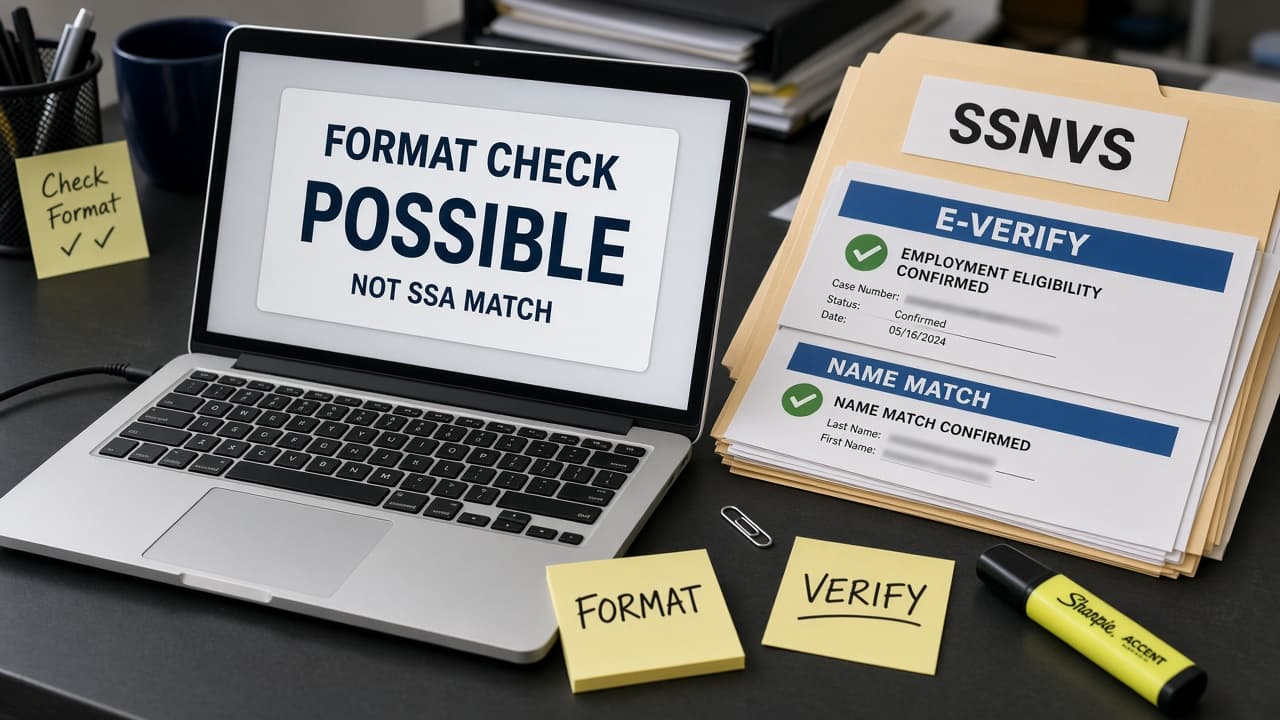
If a number avoids every reserved slot, the honest result is “possible under published rules.” That is a format statement. It is not a biography, a credit file, or a pass through SSA’s name-match services. For the line between those jobs, read SSN validation is not verification.
Documented reserved values
The published list is short. That is the useful part. Folklore sites keep adding extra “never issued” bands from old allocation tables, wallet inserts, or a guess about what looks suspicious. We do not. If SSA does not publish a reservation, we do not invent one.
SSA writes the number as AAA-GG-SSSS: a three-digit area, a two-digit group, and a four-digit serial. Hyphens are punctuation. Reservation lives in those three blocks. Randomization changed how new numbers are chosen. It did not reopen these slots.
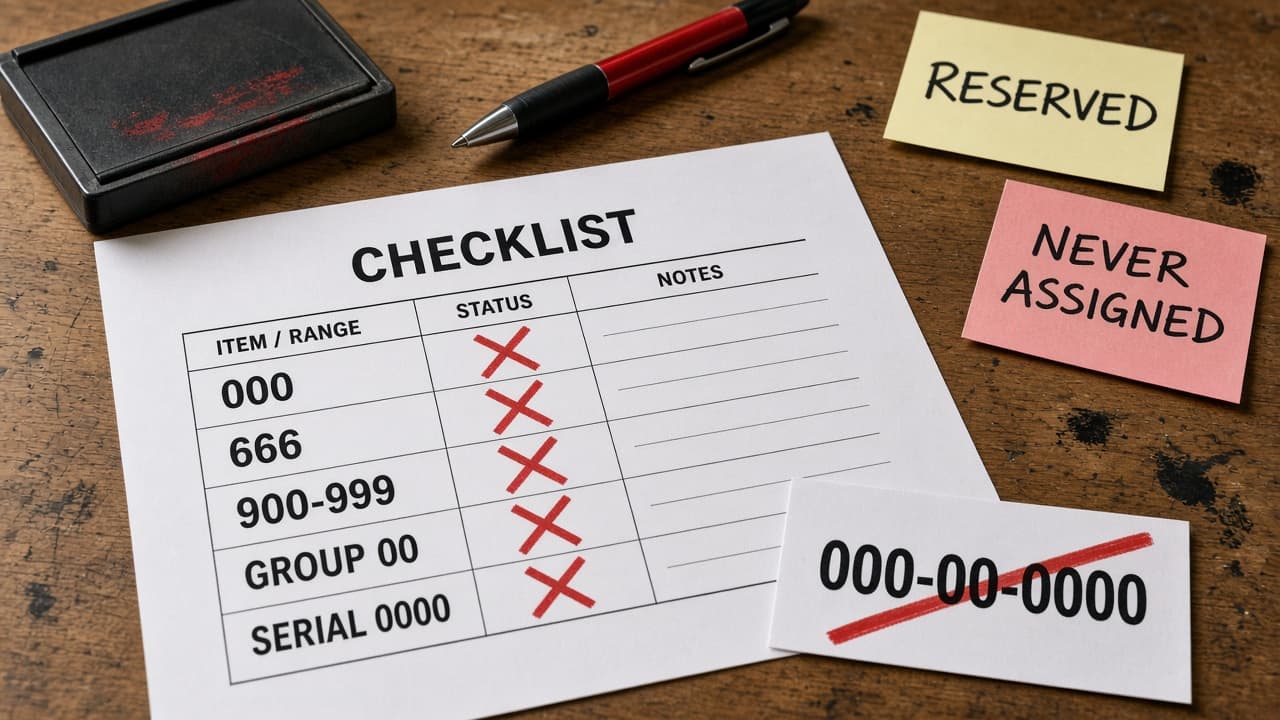
Treat the list as a closed set. A string can fail more than one rule at once (000-00-0000 fails all three blocks). A string in the 900 series with group 00 is still structurally impossible, because 00 is not an ITIN or ATIN group. Serial 0000 does not do that job. IRS ranges for those taxpayer numbers include serial 0000.
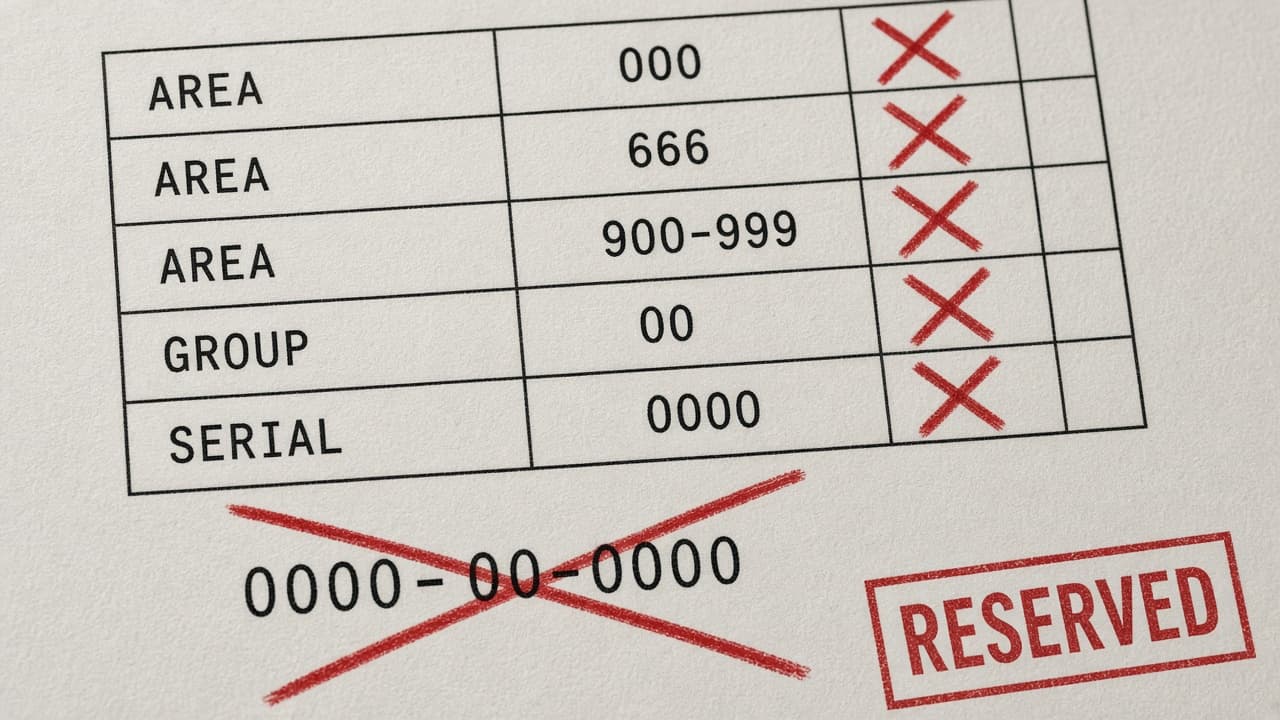
Area 000 and area 666
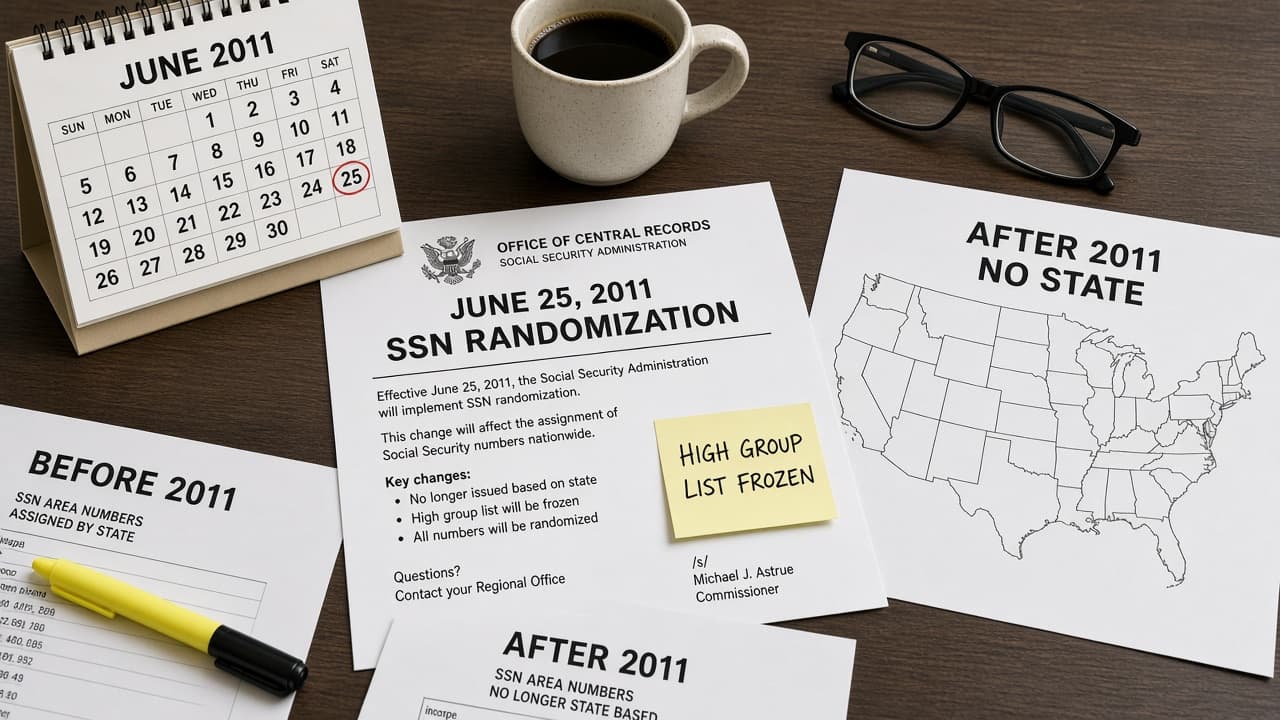
The first three digits are the area number. Before 25 June 2011 they came from a public state-and-program chart. After that date, new assignments no longer advertise a state. Two area values stayed off the chart in every era: 000 and 666.
Area 000 is the empty prefix. It is the three-digit version of “no area was issued.” SSA has never assigned it as a Social Security Number, and randomization left it closed. If you see 000 as the first block, you are not looking at a card number that ran out of luck. You are looking at a reserved pattern.
Area 666 is reserved the same way. We cite the publication, not a sermon. Some public checkers quietly add other “unlucky” prefixes as if they were in the same class. They are not. The only other area band SSA keeps out of SSN assignment is 900–999, and that band has a different owner.
Group 00 and serial 0000
The middle two digits are the group. They run from 01 through 99. Group 00 has never been assigned. Offices once opened groups in an odd-then-even ledger order, which is a teaching detail about the old system, not a second reservation list. The only group value SSA keeps unused is 00.
The last four digits are the serial. Inside a group they run from 0001 through 9999. Serial 0000 has never been assigned. Those four digits do not encode age, sex, or citizenship. Their job is uniqueness inside a group. Zeroing them out does not create a “blank card.” It creates a reserved pattern.
SSA’s randomization material is explicit that group 00 and serial 0000 stay unused after 25 June 2011. The change shuffled how new area numbers are picked. It did not start handing out all-zero groups or serials.
Group 00 still applies in the 900 series. 900-00-1234 is not an ITIN. Group 00 is outside the published IRS ranges, so the pattern is structurally impossible. Serial 0000 is an SSA rule for Social Security Numbers. IRS Publication 1915 describes an ITIN as a 9xx number with middle groups 50–65, 70–88, 90–92, or 94–99, and the published ranges include serial 0000. 900-70-0000 is an ITIN shape, not an SSN that serial 0000 knocked out. Group 93 with serial 0000 is an ATIN shape. Neither label means the IRS issued that exact number.
The 900 series cannot be an SSN
SSA does not assign area numbers 900 through 999 as Social Security Numbers. That is a reservation, not a rumor. If the first digit is 9, the string is already outside SSN assignment. Calling it a “broken Social Security Number” buries the actual identifier that may be sitting there.
The Internal Revenue Service uses the 900 series for taxpayer numbers it issues when a person must deal with federal tax and is not eligible for an SSN. An Individual Taxpayer Identification Number begins with 9 and uses published middle groups. An Adoption Taxpayer Identification Number uses the same area band with group 93. Those are IRS products. They are not SSA cards with a typo.
A payroll or benefits form that asks for an SSN is asking for an SSA-assigned number. Pasting a 9xx taxpayer ID into that box does not convert it into a Social Security Number. It puts the wrong identifier in the field. The format check should say so. It should not shout “fake.”
ITIN and ATIN are not fake-SSN folklore
The durable internet story is that any number starting with 9 is a fake SSN. That story mashes three facts into one smear. First, SSA never assigns 900–999 as SSNs. Second, many 9xx numbers are well-formed IRS ITINs. Third, a smaller set are ATINs. A real taxpayer ID is not a counterfeit Social Security Number. It is a different number with a different issuer and a narrower job.
IRS ITINs use the middle two digits in published ranges: 50–65, 70–88, 90–92, and 94–99. Those ranges are how you tell an ITIN pattern from a 9xx string that is merely “not an SSN.” Group 93 is the ATIN pattern, used when a pending adoption needs a taxpayer ID before the child has an SSN. It is not an ITIN group. Other 9xx groups can be IRS internal numbers. A 9xx number whose group sits outside the published ITIN and ATIN ranges is not a well-formed ITIN.
An ITIN is for federal tax processing. It does not authorize work, change immigration status, or pay Social Security benefits. You cannot keep an ITIN as a second SSN. After SSA issues a Social Security Number, the IRS instructions are to stop using the ITIN and ask the agency to combine the tax records. None of that is a format-check result. It is why the folklore is sloppy.
This page is the reservation and myth essay. The side-by-side format tool lives at SSN vs ITIN vs EIN. Use that classifier when you want the group check next to an EIN field. Do not read this heading as that product. An EIN prints as XX-XXXXXXX and identifies an entity, not a person. It is a third identifier, not a fourth reserved SSN area.
Folklore we do not follow
Public checkers still ship rules that were, at best, a reading of the old geographic chart and, at worst, a copy of someone else’s copy. After 25 June 2011 those readings are not current assignment rules. We keep them off the reserved list so a modern card is not branded fake because a 2009 spreadsheet never saw its area.
The two loudest leftovers are area 333 and “anything above 772.” Area 333 is not reserved. The last geographic chart listed it in Illinois (318–361), and the final High Group List shows it had already been issued. “Above 772” came from Florida’s last geographic block and from older tables that treated missing prefixes as impossible. Areas 773–899 were missing from that chart. So were the 734–749 gap numbers. Missing from a historic map is not the same as reserved. After 25 June 2011, unused areas except 000, 666, and 900–999 can also be assigned.
A third leftover is the idea that a number is fake if a downloaded High Group file does not list its group. That file is a freeze-frame of the pre-randomization ledger. It cannot see assignments made after the freeze. We will not launder it into a fraud verdict.
A frozen High Group snapshot is not a fake detector
Before randomization, SSA opened group numbers inside each area in a published administrative order. Employers who wanted a rough “has this group been issued yet” check used the High Group List: the highest group opened in each area. It was always an issuance-progress chart, not a roster of living people.
SSA froze that list when it randomized new assignments. A frozen file cannot grow with new cards. It cannot tell you whether a 2016 number has been assigned. It cannot tell you that a structurally possible number is counterfeit. Using it that way is how a format site pretends to be a registry.
We do not score “missing from High Group” as impossible. Impossible is reserved values only. If you need a name-and-number match for wages, that is SSA’s verification channel, not a spreadsheet. The validation guide keeps those products apart. The 2011 randomization article is the date and the freeze.
What randomization changed about unused areas
On 25 June 2011 SSA changed how it assigns new numbers. The project had two jobs: stop some states from running out of allocated areas while others still had unused blocks, and make it harder to reconstruct a number from public information about where and when an application was filed. Officially, the old area digit followed the filing state or mailing ZIP, not birth state. Cards already issued were not recalled or rewritten.
From that day, new area numbers are not handed out by state. Previously unused area numbers, except 000, 666, and 900–999, could enter the nationwide pool. That sentence is why “773 and above never happens” died as a current rule. It is also why a historic area name on a result is a chart lookup, not a home address.
Reservation survived the change. Group 00 and serial 0000 stayed unused. Area 000 and 666 stayed closed. The 900 series stayed out of SSN assignment. If a blog post says randomization “made every nine-digit string valid,” it skipped the paragraph SSA actually published.
The longer date-and-why essay is Why SSA randomized SSNs in 2011. This page only needs the piece that people get backward: unused is not reserved, and reserved did not expire.
Famous samples are not reserved values
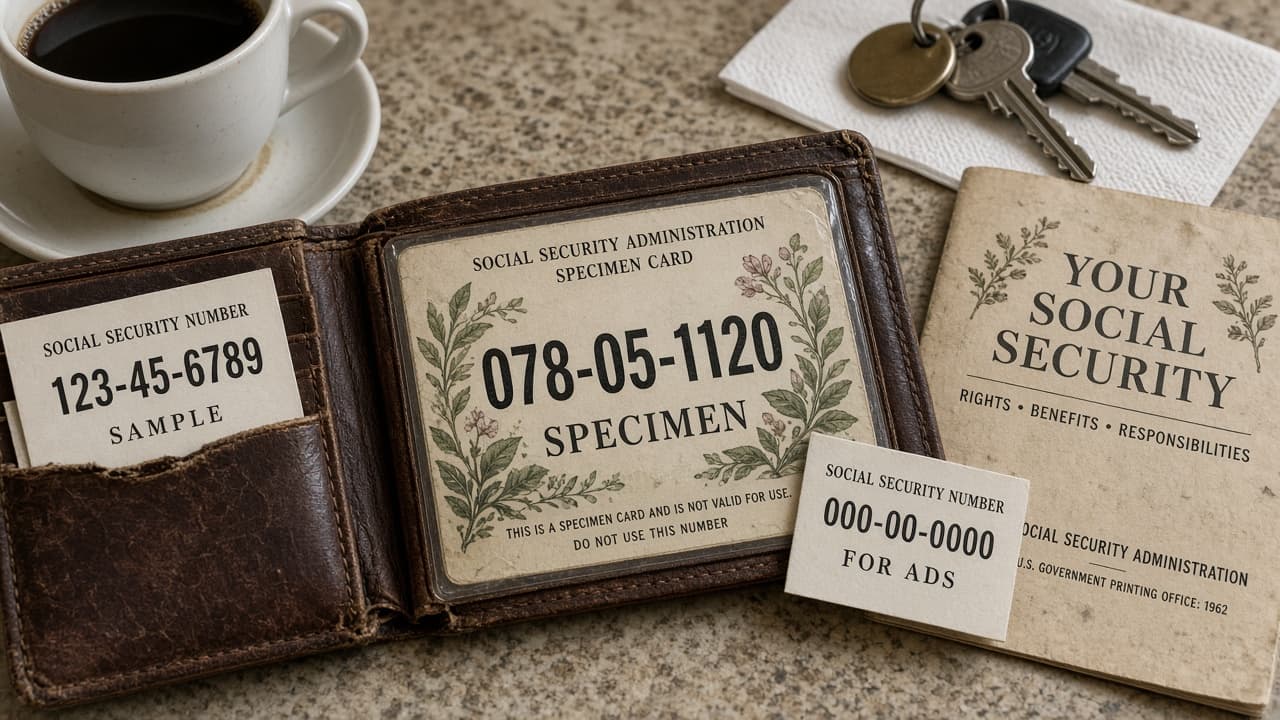
Some nine-digit strings are famous because they were printed, not because SSA reserved the pattern. 078-05-1120 came from a Woolworth wallet insert and was later voided after thousands of people used it. 219-09-9999 appeared on a 1940 SSA pamphlet cover. 123-45-6789 is a common unofficial demo. Those strings can look structurally possible. They are still samples.
The 987-65-4320 through 987-65-4329 block is a different overlap. Area 987 sits in the 900 series, so those ten numbers cannot be Social Security Numbers. People still paste them into tutorials. Current SSA guidance tells advertisers to display 000-00-0000 rather than a lookalike card number. 000-00-0000 is reserved in every block, which is why it works as a blank.
We label known samples as samples. We do not promote them into a second reserved list, and we do not keep a leaked-number graveyard. The printed-history piece is Famous sample Social Security Numbers. Use that page for the wallet and the pamphlet. Use this page for 000, 666, 9xx, group 00, and serial 0000.
What a format check can still say
In this browser the useful answers are small. The digits can be reserved, and therefore impossible as an SSN. They can be a 9xx ITIN or ATIN pattern. They can match a well-known sample. They can avoid all of that and remain possible under published rules. Possible is the end of what a public composition check is allowed to claim.
Possible is not “issued.” It is not “belongs to the name on the form.” It is not a pass at SSNVS, E-Verify, or a consent-based SSA match. Employers who need a name-and-number match use those official channels. We do not wrap a reserved-value test in that language.
If you came here because a site called a number fake for sitting in area 333, or above 772, or off a High Group dump, you can put that rule down. 333 was never reserved. Above 772 was an old chart limit. If you came here because a 9xx taxpayer ID was treated as a counterfeit SSN, take it to the ITIN classifier and read the group. If you need the issuance question answered, you need SSA, not another folklore table.
Frequently Asked Questions
Which SSN patterns are impossible?
Area 000, 666, and 900–999; group 00; serial 0000. Those are the values SSA publishes as never assigned. Area 333 was an Illinois prefix, not a reserved leftover. “773 and above” was an old chart ceiling, not a current reservation.
Is every number starting with 9 an ITIN?
No. ITINs use published middle groups 50–65, 70–88, 90–92, and 94–99. Group 93 is an ATIN. A 9xx number outside those groups is not a well-formed ITIN. Format is a tell, not an IRS confirmation.
Is a number that starts with 9 a fake Social Security Number?
It cannot be an SSN, because SSA does not assign areas 900–999. Many of those strings are ITIN or ATIN patterns, which are real IRS taxpayer IDs. Wrong identifier is not the same as counterfeit SSN.
Is area 333 never issued?
No. Area 333 sat in Illinois’s historic allocation, 318–361, and the final High Group List shows it had already been issued. It is not reserved. After 25 June 2011, unused areas except 000, 666, and 900–999 can also be assigned.
Are areas 773 and above impossible?
No. 773–899 were not on the old geographic allocation chart. Randomization allows unused areas except 000, 666, and 900–999 to be assigned nationwide. Off the old map is not reserved.
Does a missing High Group entry mean the number is fake?
No. SSA froze the High Group List in 2011. It cannot see randomized-era assignments. A frozen snapshot is not a registry.
Is 900-00-1234 an ITIN?
No. Group 00 is reserved even in the 900 series. The pattern is structurally impossible, not a taxpayer ID that failed a style check.
Can a public site tell whether SSA assigned a number?
No. Reserved-pattern checks can only apply published composition rules. Only SSA can confirm assignment to a person. See the validation guide for that split.