Why people say verify when they mean format
Search boxes, payroll vendors, and people-search ads all use “SSN verification” as a catch-all. The phrase sounds official. It usually is not. Some pages run a few composition rules in the browser and stamp the result “valid.” Others sell a name, a relative, or a death-index hit and still call it verification. A smaller set of programs actually query government records, and those programs are not public websites.
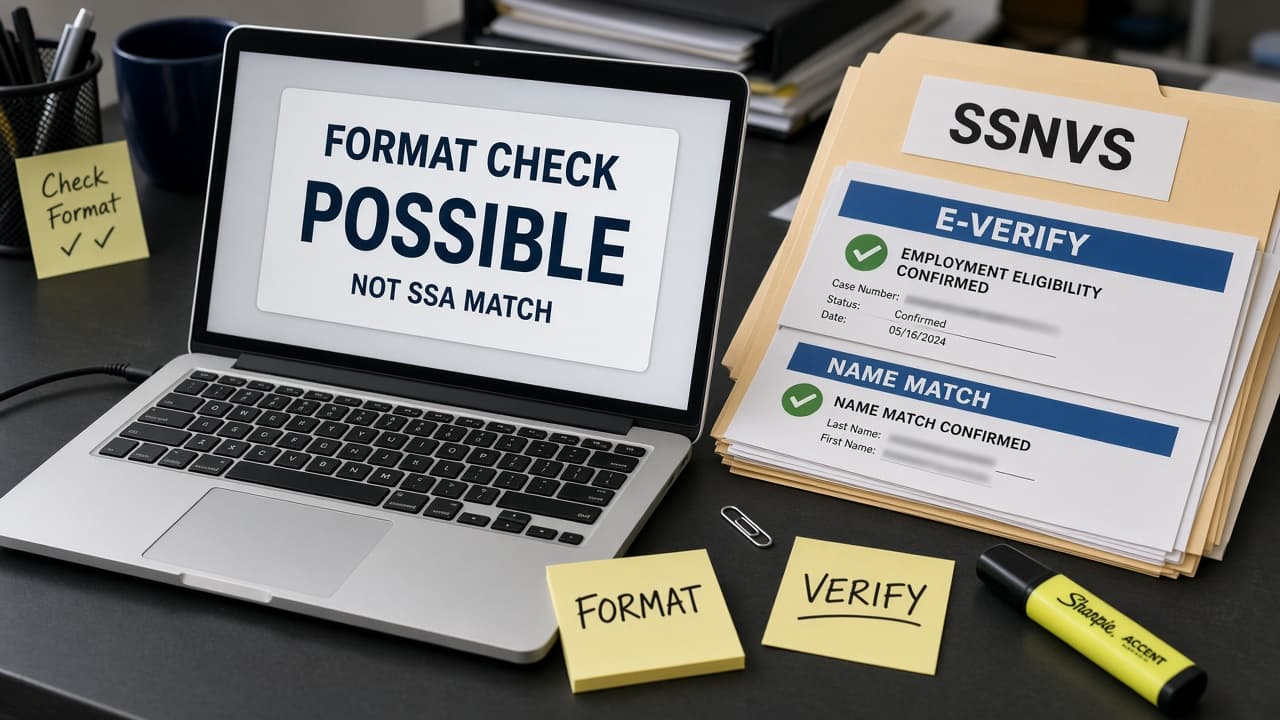
The useful split is simple. Validation, as this site uses the word, asks whether nine digits could be a Social Security Number under published rules. Verification, in the official sense, asks whether a name (and often a date of birth) matches the number in Social Security Administration records, or whether a new hire is authorized to work. Those are different questions. Mixing them up sends a typo to a government file, or treats a green format badge as a hiring or credit decision.
This page maps the channels. It is educational, not legal advice. Enrollment rules, consent forms, and anti-discrimination duties change. Read the current SSA and E-Verify pages before you enroll or act on a mismatch.
What a format check actually does
Here, validation means checking nine digits against published composition and reservation rules, and, when the area still appears on the old public chart, noting that historic allocation. The work runs in your browser. Nothing is uploaded. No name field exists because we cannot match a person.
A single-number check is SSN Validator. A list of up to 200 unique values is the bulk format checker. Both tools classify digits. They do not query Numident, return “verified,” or tell you who holds the number.
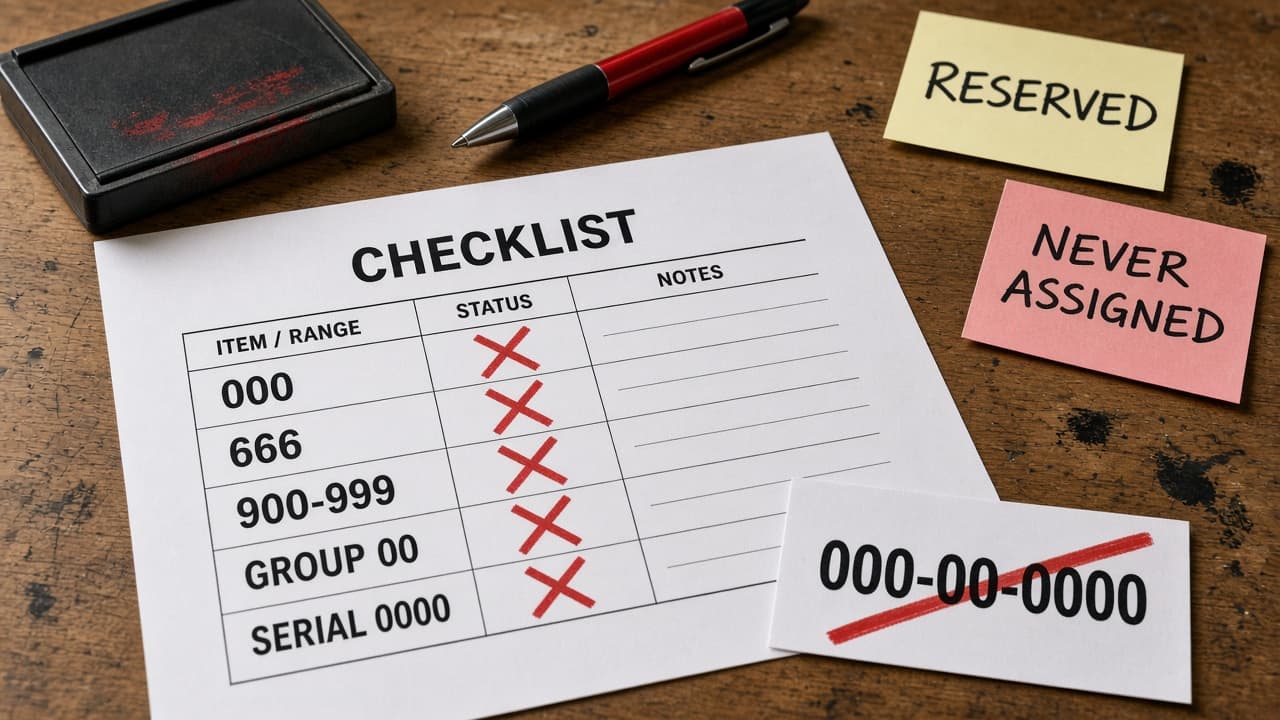
Possible means the digits follow published rules: not area 000 or 666, not group 00, not serial 0000, and not the 900 series that SSA never assigns as Social Security Numbers. Impossible means a reserved pattern. Sample means a famous placeholder such as 123-45-6789. None of those labels is a pass or fail at SSA. Do not type someone else’s number into a public page, including this one. Habits for forms and leaks are in How to keep a Social Security Number private.
Why a public site cannot say a number was issued
Before 25 June 2011, area numbers followed a public state chart and SSA published a High Group List of the highest group issued in each area. Some checkers treated a missing group as proof a number was “fake.” That shortcut was already imperfect. After randomization it is unusable for new cards. SSA froze the High Group List. Unused areas except 000, 666, and 900–999 can now be assigned. Geography disappeared from new prefixes.
SSA does not publish a who-holds-this-number list. There is no public Numident. A site that claims “issued,” “active,” or “belongs to” from digits alone is guessing or selling a different database. After 2011, even a perfect historic decoder cannot see whether a modern number was assigned. Only SSA can confirm assignment to a particular person.
What official verification is
Official verification talks to government records. The employer programs that matter for a name-and-number match are SSA’s Social Security Number Verification Service and, for work authorization, E-Verify at the Department of Homeland Security. Enrolled companies that have the number holder’s consent use CBSV or eCBSV. Those systems compare submitted data to SSA (and, for E-Verify, DHS) files. This website does not.
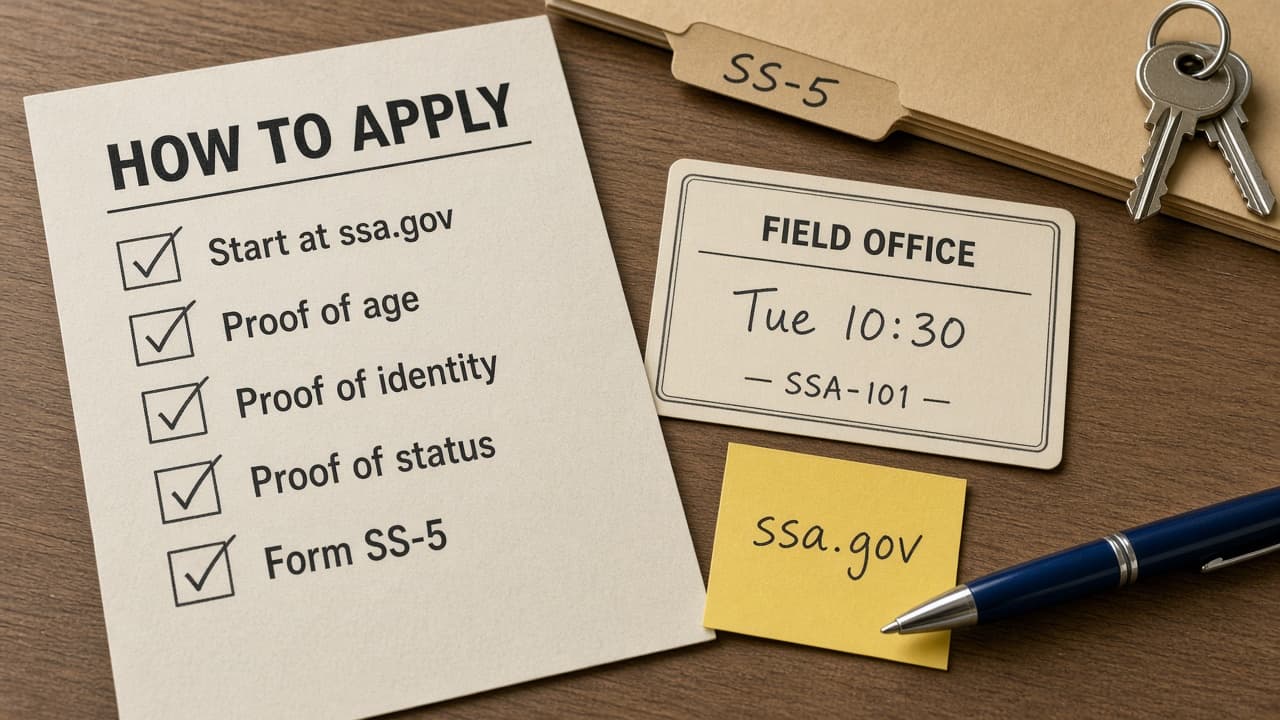
A consumer who wants a replacement card, a corrected record, or a my Social Security account goes to SSA directly. Third-party funnels that charge to “apply” or “register” a number are not the official path. The steps live in How to apply for a Social Security Number.
SSA’s SSNVS for Form W-2
SSNVS is SSA’s employer service for matching a name and Social Security Number to SSA records before wage reporting. The job is to keep Form W-2 accurate so earnings post to the right record. Unmatched names cost employers processing time and can leave a worker’s earnings uncredited for retirement, disability, or survivors benefits. The current overview is at ssa.gov/employer/ssnv.htm.
Registered employers and third-party wage-reporting agents (payroll services, accountants, or tax preparers acting on a client employer’s W-2s) use Business Services Online. On screen they can check up to 10 names and numbers at a time. They can also upload a file of up to 250,000 and usually get results the next government business day. SSA offers the service at no charge. A private vendor that resells a “bulk SSN check” is not SSNVS unless it is a contracted wage-reporting agent using the official channel.
Use is narrow. SSA says SSNVS is for current or former employees, and only for wage reporting. A current employee, in SSA’s pamphlet, is someone who has received and accepted a job offer. Do not use SSNVS to screen applicants before a hire, to check contractors, to prepare tax returns, or to run identity, credit, or mortgage checks. Restrictions are at ssa.gov/employer/ssnvrestrict.htm. SSA reviews usage.
A mismatch is not a statement about immigration status. SSA tells employers not to take punitive action from a mismatch alone. The information is not work authorization. That is a different program.
E-Verify for employment eligibility
E-Verify is a DHS program, run by USCIS, that compares information from Form I-9 to records available to SSA and DHS. The question it answers is whether a newly hired employee is authorized to work in the United States. It is free for enrolled participants. The official site is e-verify.gov.
E-Verify is a companion to Form I-9, not a replacement. Employers use it after a job offer is accepted and the I-9 is completed. It is not a prescreening tool, not a background check, and not a public registry. An “Employment Authorized” result does not mean the person can hold any job, only that employment eligibility was confirmed for that case.
E-Verify.gov states the difference from SSNVS in one sentence that is worth keeping: E-Verify confirms employment eligibility of newly hired employees; SSA’s program verifies that a name matches a Social Security Number. A person can have a valid SSN and still not be authorized to work. A format-possible number on this site says even less. It does not speak to work, immigration status, or a name.
CBSV and eCBSV with the holder’s consent
Consent-Based Social Security Number Verification (CBSV) is an SSA service for enrolled companies. With the number holder’s written consent on the current Form SSA-89, the company submits a name, SSN, and date of birth. SSA returns a yes or no match. If records show the holder is deceased, CBSV returns a death indicator. SSA is explicit: CBSV does not verify identity, citizenship, or employment eligibility, and it does not satisfy Form I-9. Details live at ssa.gov/cbsv.
Enrollment is not walk-up. A company needs an EIN, a user agreement, and fees that SSA sets and can change: an initial enrollment charge plus a per-verification charge. SSA says typical users include banks, mortgage lenders, background-check firms, and licensing programs, and the list is not closed. You hand the signed form back to the company, not to SSA. Classic CBSV still expects that paper (or imaged) consent in hand before the query.
eCBSV is the electronic sibling created after section 215 of the Economic Growth, Regulatory Relief, and Consumer Protection Act (the 2018 Banking Bill). It is a fee-based SSA data-exchange service for permitted entities: financial institutions under the Gramm-Leach-Bliley Act, and their service providers, subsidiaries, affiliates, agents, subcontractors, or assignees. Those entities certify eligibility to SSA. The holder’s consent may be wet or electronic. The match is still name, SSN, and date of birth against SSA records. SSA’s user agreement says that match is not proof of identity. Start at ssa.gov/dataexchange/eCBSV.
If you are not a permitted entity, or you need a use outside that statute, you stay on classic CBSV with a signed SSA-89. Neither service is a people-search portal, and neither is this website.
Side-by-side: which product does what
Read this as a map, not a ranking. Each row is a different product. A browser format check cannot stand in for any official channel, and an official channel cannot be replaced by a people-search dump.
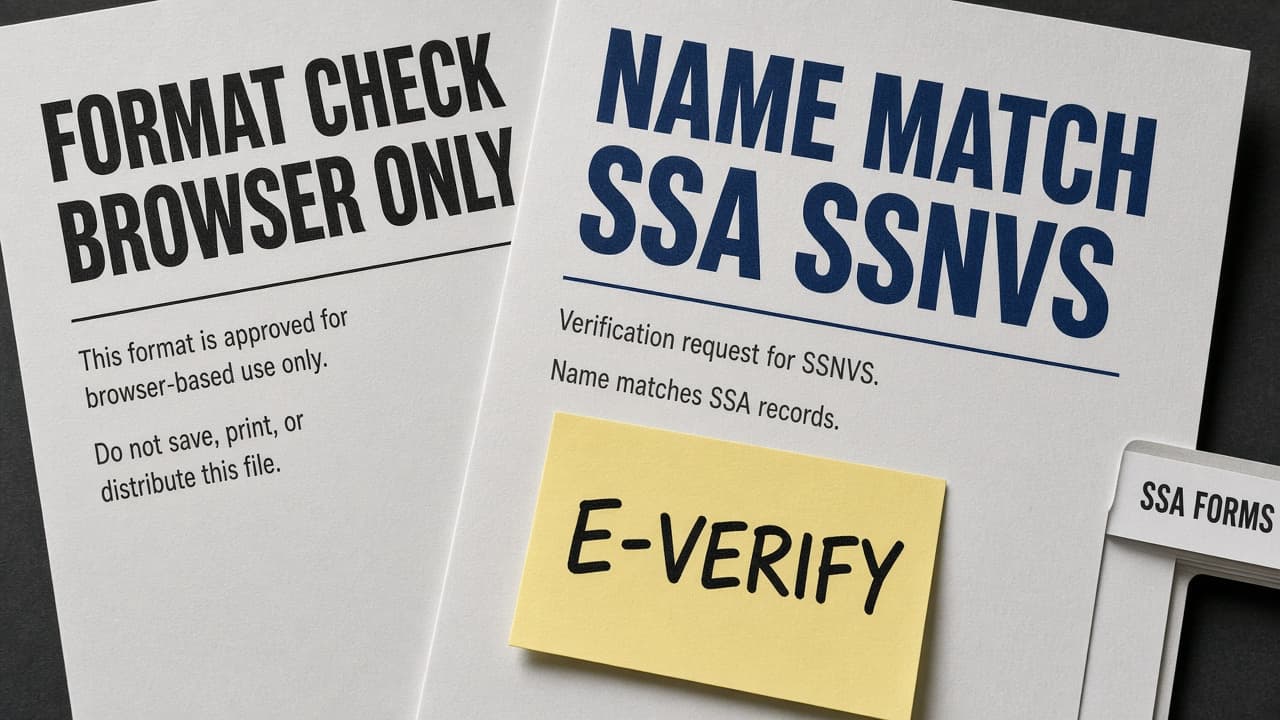
- Format check (this site)anyone can paste digits in a browser. Checks published format and reservation rules only. No name, no date of birth, no SSA query. Catches reserved patterns, famous samples, and obvious typos. Does not confirm assignment, identity, work, credit, or death.
- SSNVSregistered employers and wage-reporting agents. Matches name and SSN of current or former employees for Form W-2. A current employee, in SSA’s pamphlet, includes someone who has accepted a job offer. Free from SSA. On-screen batches of 10, or a file up to 250,000. Not for applicants, contractors, credit, or identity. Not work authorization.
- E-Verifyenrolled employers after Form I-9. Compares I-9 data to SSA and DHS records to confirm employment eligibility. Free. Complements I-9; does not replace it. Not a background check or a public registry. A valid SSN is not the same as work authorization.
- CBSVenrolled companies with the holder’s signed Form SSA-89. Matches name, SSN, and date of birth. Yes or no, plus a death indicator. Fee-based. Does not prove identity, citizenship, or I-9 compliance.
- eCBSVpermitted financial institutions and their service providers, with wet or electronic consent, only for a credit transaction or another purpose described in FCRA section 604, as the Banking Bill and SSA’s user agreement require. Same style of match as CBSV. Still not proof of identity. Not a public API.
- FCRA or people-search reporta private-sector file that may be a consumer report. Uses vary and are regulated when they are consumer reports. This site is not a consumer reporting agency and does not sell those dumps.
FCRA reports and people-search sites
The Fair Credit Reporting Act covers consumer reports used for credit, employment, insurance, housing, and related decisions. Consumer reporting agencies have duties. Users of those reports have duties. A public format result is not a consumer report, and it is not a lawful stand-in for one. We are not a consumer reporting agency. Do not use a “possible” label here to hire, deny credit, price insurance, or rent an apartment.
People-search and “full SSN report” vendors are a different market. Some scrape public records. Some resell older files. Some advertise death-index hits or relatives attached to a number. That is not SSA verification. It is also not something this site sells. We do not offer reverse lookup by name, we do not attach a biography to nine digits, and we do not ship death-master dumps.
If a bank or lender asks you to sign Form SSA-89, that is the consent path into CBSV or eCBSV, not a people-search checkout. If a job asks you to complete Form I-9, that is the E-Verify path when the employer is enrolled. If a site asks you to pay to “verify any SSN” with no government enrollment story, treat the claim as marketing.
How to pick a channel
Start from the decision you actually have to make, not from the word “verify.”
You want a sanity check on digits before they land in payroll, a vendor form, or a QA sheet: use SSN Validator for one number, or the bulk format checker for a list. Fix reserved patterns, fragments, and famous samples in your own source file first. That pass does not replace an official match.
You are an employer who needs names on Forms W-2 to match SSA: enroll in SSNVS. You hired someone and need employment eligibility: complete Form I-9, then E-Verify if you participate. You are a permitted financial institution with the holder’s consent and a Banking Bill use: eCBSV. You are another enrolled company with a wet-signature SSA-89: CBSV. You are a payer matching a payee name to a TIN for information returns: that is IRS TIN Matching, a separate IRS program, not SSNVS and not this site.
You need your own card, a correction, or a first-time number: go to SSA. The walkthrough is the apply guide. You need to lock down a number that leaked: start at IdentityTheft.gov and see the privacy guide. A format website cannot file a freeze or flag a record for you.
What this page is not
This article is a map of products. It is not legal advice, not an enrollment guide, and not a substitute for SSA, DHS, or IRS instructions. SSNVS restrictions, E-Verify mismatch procedures, and CBSV consent rules are real. Getting them wrong can create discrimination or Privacy Act problems. Read the current official handbook for the program you intend to use.
We will not pretend to be a consumer reporting agency, a people-search bureau, or a government lookup. Results here are not for Fair Credit Reporting Act decisions. We do not sell “full reports,” reverse name search, or death-index hits. If you need a name on the card, use the official channel that matches that job.
Frequently Asked Questions
Is this official SSA verification or SSNVS?
No. This site is an independent format checker. Employers who need a name-and-number match use SSA’s SSNVS. Work authorization is E-Verify. Consent-based matches for enrolled companies are CBSV or eCBSV.
Can I validate an SSN by name?
Not here. A name-and-SSN match is SSA’s SSNVS for registered employers (Form W-2), or CBSV/eCBSV with consent. We do not offer people search or reverse lookup by name.
Does this site confirm that an SSN belongs to someone?
No. We only apply published format and reservation rules. Only the Social Security Administration can confirm that a number was assigned to a particular person.
Is a possible result the same as a pass at SSNVS?
No. Possible means the digits follow published rules. SSNVS matches a name and number against SSA records for lawful wage reporting.
Is E-Verify the same as SSNVS?
No. SSNVS matches a name to an SSN for Form W-2. E-Verify checks Form I-9 data against SSA and DHS records to confirm employment eligibility. A person can have a valid SSN and still not be authorized to work.
What is the difference between CBSV and eCBSV?
Both match name, SSN, and date of birth with the holder’s consent. CBSV is the older enrolled-company service and uses Form SSA-89. eCBSV is the electronic service for permitted entities under FCRA section 604, expanded by the 2018 Banking Bill, and allows electronic consent. Neither proves identity, and neither is this website.
Can I use a format-check result for hiring, credit, or housing?
No. A possible or impossible label here is not for hiring, credit, insurance, or housing decisions.
Can I check a list of numbers here?
Yes. The bulk format checker classifies up to 200 unique values in your browser. It is not SSA’s SSNVS file upload. SSNVS is a registered employer service that matches a name and SSN for Form W-2.