Not every number starts at a field office
The picture many people still carry is an adult at a Social Security office, Form SS-5 in hand, waiting for a window. That path exists. It is not how most original numbers are created now, and it was never the only path.
This page owns two official programs that collect a request without that visit. SSA still assigns the number. Enumeration at Birth lets a parent request a number while a hospital, birthing center, or licensed midwife is already collecting birth-registration data. Enumeration at Entry lets a lawful permanent resident request a number on the immigrant-visa application. After admission, SSA assigns the number and mails the card. A historic Railroad Retirement Board band marked railroad enumerations rather than a state. People already in the United States sometimes request a card on a USCIS form instead. That channel changes. Read SSA’s live immigration-number pages.
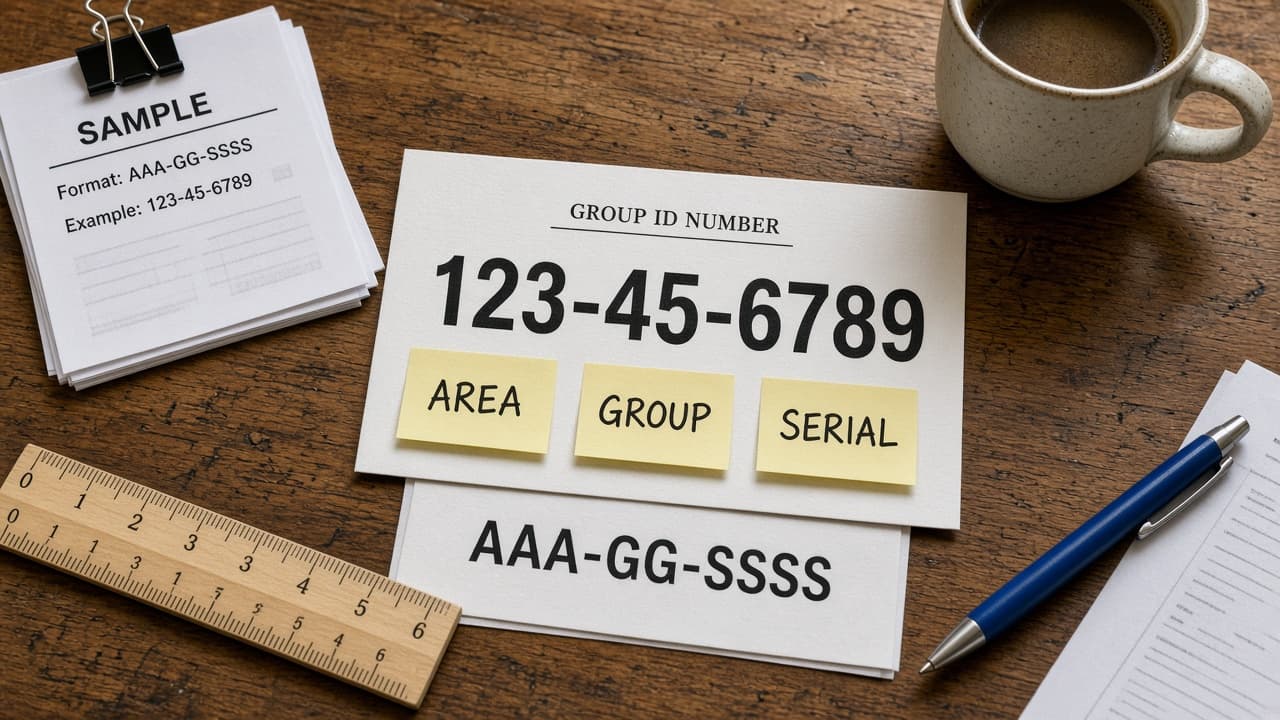
Those channels matter for anyone who still treats the first three digits as a birth-state stamp. A hospital mailing ZIP, a visa address, or a program prefix can sit on the application that SSA actually used. The print shape AAA-GG-SSSS is explained in What AAA-GG-SSSS used to mean. This page is about the processes that skip a state field office, and why a hometown guess falls apart when it meets them.
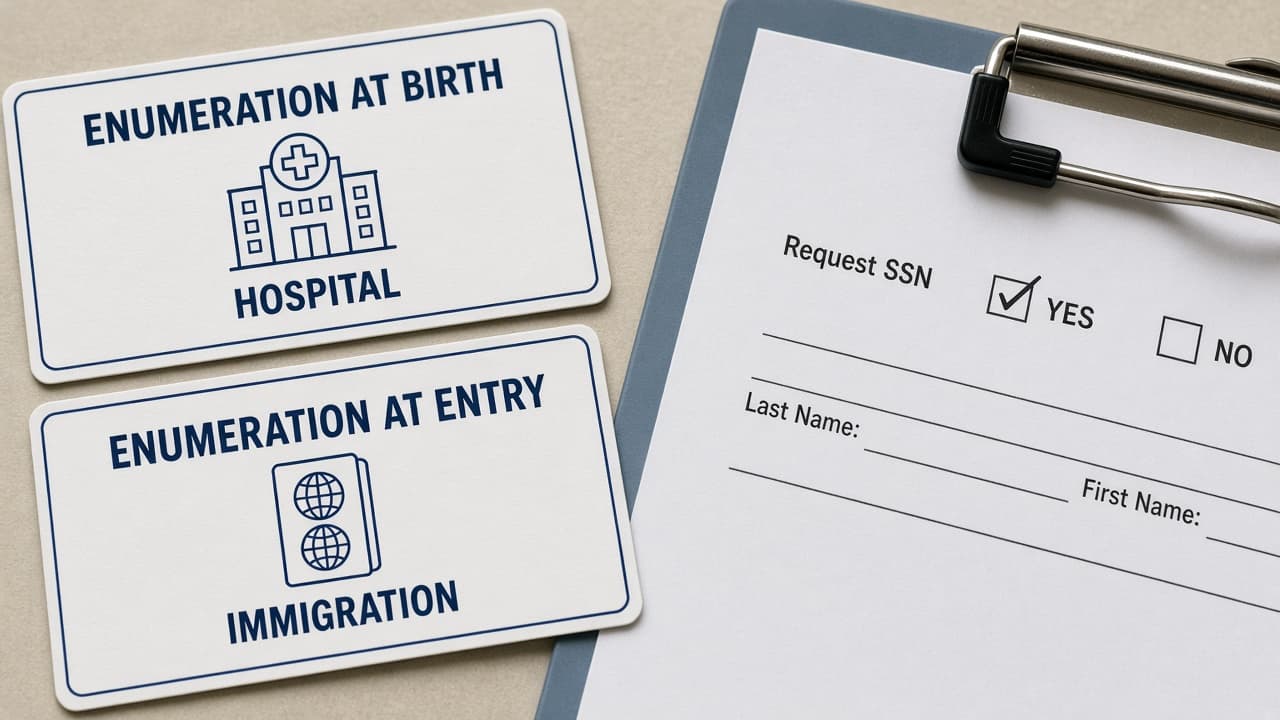
Enumeration at Birth: the hospital checkbox
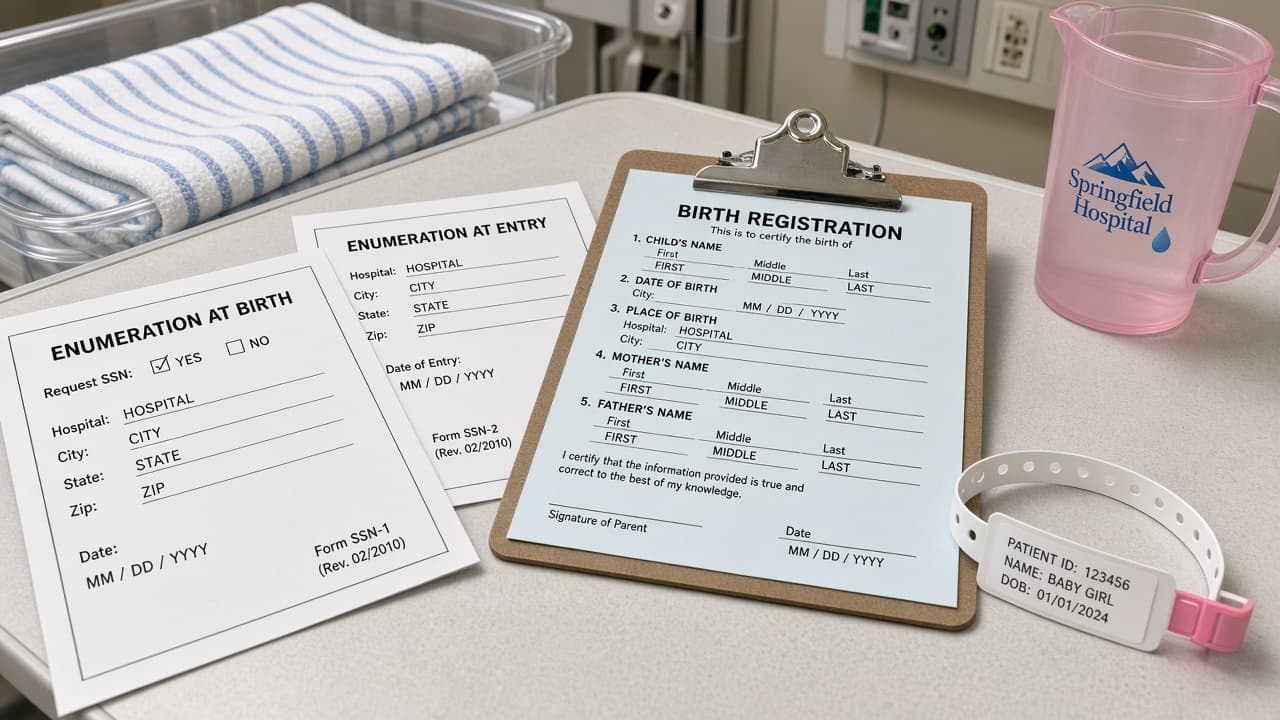
Enumeration at Birth is SSA’s name for assigning a newborn’s Social Security Number as part of state birth registration. When the hospital representative takes the information for the birth certificate, the form also asks whether the parent wants that information forwarded so SSA can assign a number. A check in that box, plus the parent’s signature on the registration, is the application. There is no separate SS-5 sitting in a microfilm drawer for that record.
SSA piloted the idea in August 1987 in New Mexico, Iowa, and Indiana. The program expanded nationwide in 1989. By 1997 every state was in, along with New York City, the District of Columbia, and Puerto Rico. The Commonwealth of the Northern Mariana Islands joined in 2021. SSA’s current processing notes still describe EAB as voluntary for parents and for hospitals, and still say nearly all infant numbers now arrive through it.
The convenience is the point. Age, identity, and citizenship evidence for a newborn already sit on the birth-registration worksheet. Parents do not gather certified copies, fill a second federal form, or stand in a field-office line. The state vital-records agency sends an electronic record. SSA assigns the number, mails the card, and posts the birth proof on its own record.
What happens after a parent says yes
The hospital (or birthing center, or licensed midwife) forwards the checked registration to the state’s vital-records office. In some places a county or local registrar sits in the middle. The vital-records agency then transmits an electronic enumeration record to SSA. SSA uses that file to assign the number and print a card. On SSA’s Numident, a record created this way carries a form code for Enumeration at Birth. The public nine digits do not advertise that code.
Parents who apply this way receive Form SSA-2853, a short message from Social Security that serves as a receipt. It is not the card. The card is mailed to the address on the registration. SSA’s current FAQ lists a national average of about two weeks, plus mail time. State times differ. Read that FAQ the week you wait. If the wait has passed and the envelope has not arrived, the next stop is SSA, not a format website.
EAB issues original cards for newly registered infants. It is not a replacement-card machine, and state vital-records offices are not supposed to send SSA an EAB record for a corrected birth certificate, an amended certificate, or an infant adoption. Those cases leave the hospital checkbox and become ordinary applications. The official how-to lives in How to apply for a Social Security Number.
The address on the form is a mailing story
From 1972 until randomization, SSA chose the area number from the ZIP code on the original application. Enumeration at Birth did not invent a special exception. The “application” is the birth-registration packet. The address on that packet is a mailing ZIP, usually a parent address. It does not have to be the house the family occupies six months later, and it does not have to be the state printed on a later school form.
A child can be born in one state, registered from a hospital whose mailroom sits in another ZIP band, and grow up in a third. The card still arrives. The first three digits, if the number was assigned before 25 June 2011, still followed the mailing ZIP SSA was given, not a secret birth-state field. After that date, new numbers do not follow a ZIP at all.
That is why “the area matches the birth certificate, so the number is genuine” is a broken test. A match can happen. A mismatch can happen. Neither result is a biography, and neither result is an SSA issuance check. The public historic bands sit on SSN Area Numbers. They are a chart of old allocations, not a proof of where someone was born.
Why birth-state guesses fail
The parlor trick people still try is simple: take a birth state and an approximate year, read a public area chart, then claim the first three digits, or even the first five. That already mixed up birthplace with the filing state or mailing ZIP. The trick was sloppy before hospitals started checking a box. It is useless for new cards. Here is why it fails on both sides of 25 June 2011.
Until 1972 the area usually reflected the state where the application was filed. People applied away from home: students, service members, workers who had already moved, parents who registered a child from a hospital that was not “home.” From 1972 through 24 June 2011 the area followed the mailing ZIP on the application. A ZIP is a postal instruction. It is not a birthplace, and it is not a promise of later residence. Enumeration at Birth made that mailing story ordinary for almost every U.S. newborn.
Some prefixes were never states in the first place. Areas 700–728 marked Railroad Retirement Board enumerations. Areas 729–733 marked Enumeration at Entry. A chart row that says “program,” not “Ohio,” cannot be turned into a hometown by wishing. Shared or split state ranges make even the geographic rows ambiguous. The full historic table belongs on the area chart. This page will not reprint it.
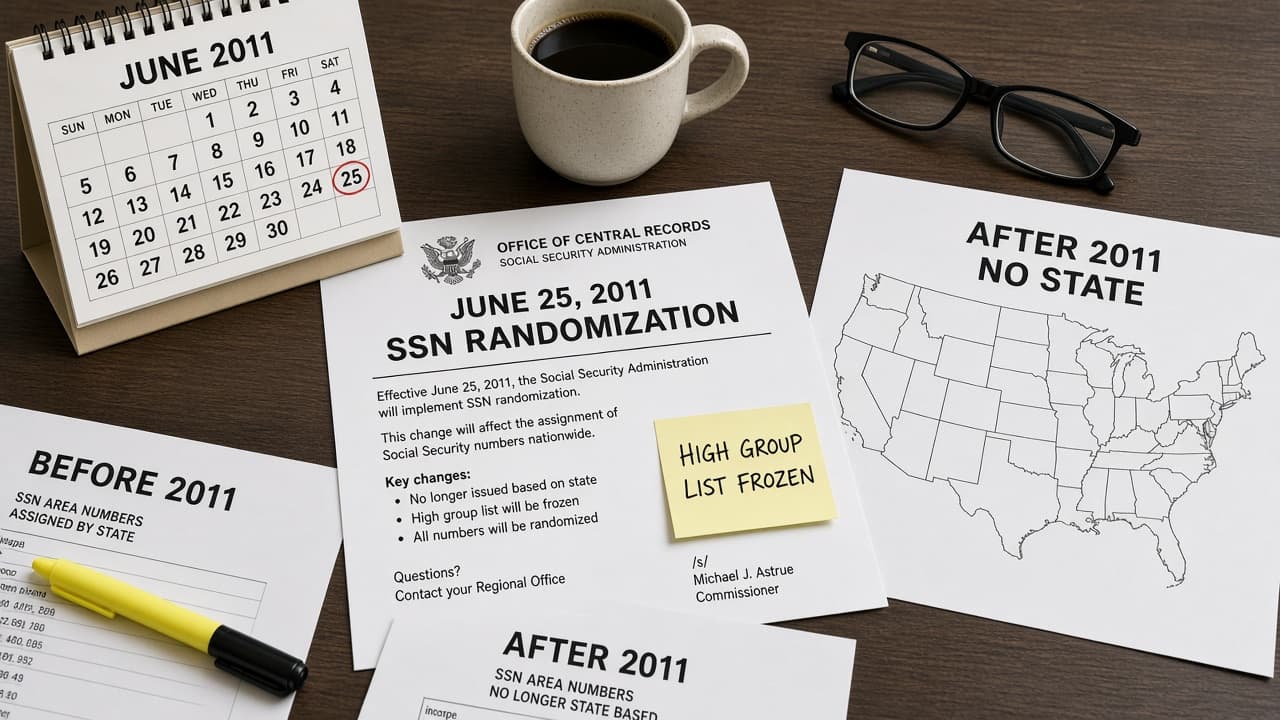
On 25 June 2011 SSA randomized new assignments. New area numbers are not handed out by state. Unused 700–728 numbers were put in the nationwide pool. New Enumeration at Entry cards are assigned at random, not from 729–733. A modern card can carry 731 or 712 without being an immigrant-process relic or a railroad record. The date, the reason, and what a checker can still say are in Why SSA randomized SSNs in 2011. We will not reconstruct the first five digits from a filing place and a year. That is the trick randomization was built to stop.
Enumeration at Entry and areas 729–733
Enumeration at Entry is an immigration channel, not a state code. SSA has agreements with the Department of State and the Department of Homeland Security so a person admitted as a lawful permanent resident can request a Social Security Number on the immigrant-visa application, Form DS-230 or DS-260, instead of filing SS-5 at a field office after arrival.
The handoff is sequential. State collects the enumeration data with the visa. When the person is physically admitted at a port of entry, Customs and Border Protection updates the file and Homeland Security transmits it to SSA. SSA then assigns an original number or mails a replacement card, as the record requires, to the U.S. address on the immigration file: the visa form or the address given at the port of entry. SSA’s public timing note says the card should arrive about seven to ten business days after admission. The Department of State handout tells people to contact SSA if it has not arrived within three weeks. Either way, the address is a visa or admission mailing address, not a childhood hometown.
Before 25 June 2011, original numbers issued through this channel used area numbers 729–733. That band is a process marker on the public chart. It does not mean “born abroad,” and it does not mean “lives in a particular state.” After randomization, Enumeration at Entry still exists as a process. New original numbers from that process are assigned randomly, the same as other new numbers. A 731 prefix on a 2014 card is not proof of Enumeration at Entry. A 731 prefix on a 2008 card is a historic-channel clue, not a biography.
Railroad Retirement Board areas 700–728
Areas 700–728 are the other program band this page owns. They were reserved for Railroad Retirement Board enumerations. They were never a U.S. state, never a territory, and never a birthplace code. A prefix in that range on a card issued through 30 June 1963 is a historic program mark: the Railroad Retirement Board issued original Social Security Number cards in the 700–728 series to railroad employees.
That issuance stopped on 1 July 1963. From that day SSA assigned numbers to railroad employees from the regular area series, the same pool everyone else used. The 700–728 band sat on the public allocation chart as a retired program row. It did not start meaning “Illinois” or “Pennsylvania.” It also did not keep minting new railroad numbers for the next half century.
Randomization put unused values from 700–728 into the nationwide assignment pool. A 700-series prefix on a card issued in 2016 is not evidence of a railroad job, a railroad pension, or a mid-century application. Treat 700–728 the way you treat 729–733: a chart note about a historic channel, useful when the number is old enough for the channel to apply, and silent when it is not.
What those program bands mean after 25 June 2011
Randomization did not erase cards already issued. A number assigned through Enumeration at Entry in 2009 still begins with 729–733. A railroad card from the early 1960s can still sit in 700–728. What changed is the meaning of a fresh assignment. Unused area numbers, except 000, 666, and 900–999, could be given to anyone, anywhere in the country. Unused 700–728 numbers were put in that pool. New Enumeration at Entry cards are assigned at random.
That is why a format check on this site may still name Railroad Retirement Board or Enumeration at Entry when the first three digits fall in those historic ranges. The label is a chart lookup. It is not a finding that SSA used that program for this person, and it is not a finding that the number was issued. After 25 June 2011 the same digits can appear on a randomized card with no railroad or immigration story attached.
Do not upgrade the label. “Historic Enumeration at Entry band” is not “this person entered through a port last year.” “Historic Railroad Retirement Board band” is not “this person worked for a railroad.” If you need the assignment date or the channel SSA actually used, that is a Numident question. Only SSA can answer it. The broader 2011 change is in the randomization article.
When Enumeration at Birth is not the path
EAB is voluntary. A parent can leave the box unchecked and apply later. A birth that never goes through a participating hospital packet (some home births, some delayed registrations, some out-of-country births) never enters the electronic EAB feed. SSA’s instructions to vital-records agencies also keep corrected certificates, amended certificates, and infant adoptions out of that feed. Those children still need a number. They do not get it from the hospital checkbox.
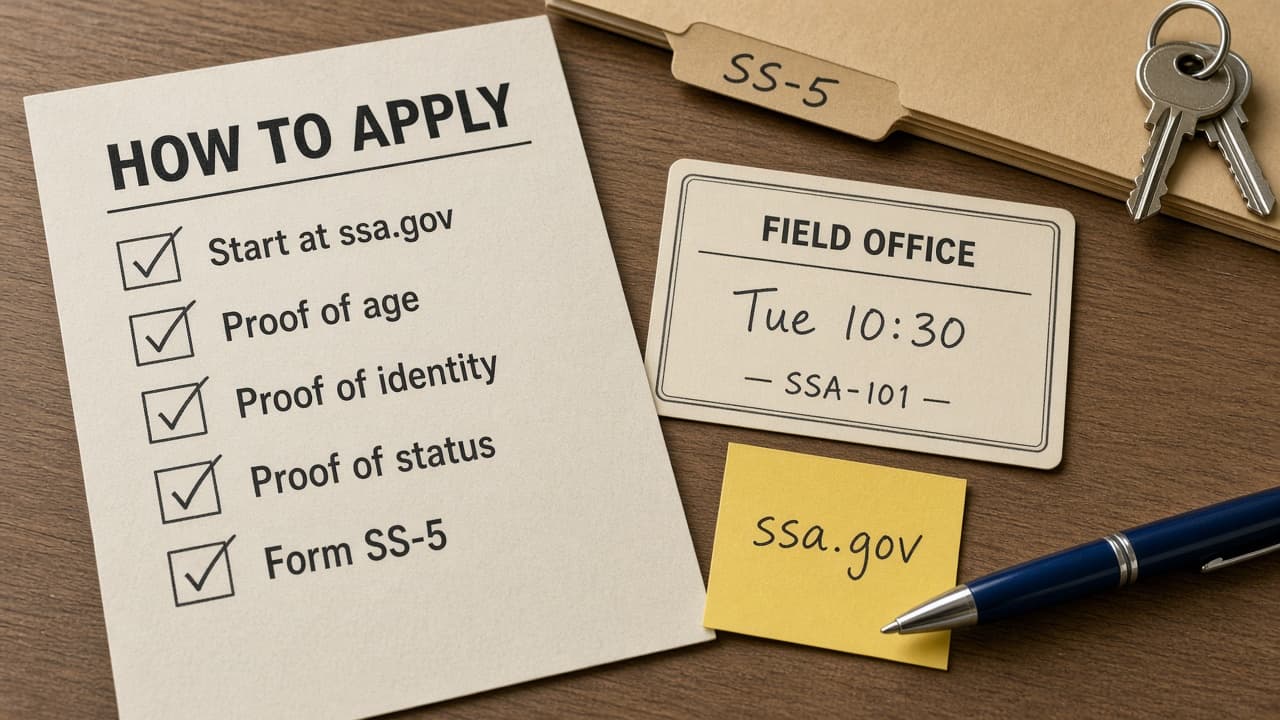
Adults, many teens, and anyone whose first card was never created through EAB or Enumeration at Entry still use the ordinary application. That walkthrough, including where Form SS-5 lives and why a third-party funnel cannot accept it, belongs in the apply guide. This page will not repeat the document list or the office steps. The only point here is the fork: hospital or visa channel on one side, field-office application on the other.
Replacement cards are the other fork people mix up. EAB issues an original infant card. Losing that card later is not a second Enumeration at Birth. The replacement request goes to SSA. A public checker cannot print a new card, and a vital-records office should not re-send an EAB record to stand in for a replacement.
What this site will show, and what it will not
Our special area listings name Railroad Retirement Board (700–728) and Enumeration at Entry (729–733) so a format check can explain an unusual prefix instead of inventing a state. We do not reconstruct year-by-year prefixes for those programs. We do not estimate anyone’s age from a group number. We do not turn a hospital checkbox into a birth-state confirmation.
The historic state, territory, and possession chart is a pre-25 June 2011 allocation table. Do not use it as a people search. The print-shape history lives in the AAA-GG-SSSS guide. How to file a real application lives in the apply guide. What 25 June 2011 changed for new cards lives in the randomization article.
Possible, on this site, means the digits follow published composition rules. It does not mean SSA assigned the number, and it does not mean the number belongs to the person you have in mind. Hospital programs and immigration programs are why that gap is not a quibble. A huge share of original numbers never sat on a field-office desk in the state you would guess from a birth certificate.
- SSN Area Numbershistoric state and program bands for the first three digits, pre-25 June 2011 only
- What AAA-GG-SSSS used to meanwhat area, group, and serial used to do on the card
- 2011 randomizationwhy new numbers are no longer a geography puzzle
- How to applythe official SS-5 path when EAB or Enumeration at Entry is not available
Frequently Asked Questions
How do most U.S. newborns get a Social Security Number?
Through Enumeration at Birth. A parent answers yes on the hospital, birthing-center, or midwife birth-registration form. The state vital-records office sends the file to SSA. The card usually arrives by mail.
Does Enumeration at Birth prove the area is the birth state?
No. The application address is the mailing ZIP on the birth-registration record, usually a parent address. Even before 2011 that was not a sure birthplace. After 25 June 2011 new numbers are randomized.
What is Enumeration at Entry?
An immigration channel for requesting a Social Security Number without a state field-office visit. A lawful permanent resident can request the number on Form DS-230 or DS-260. After admission, SSA assigns the number and mails the card.
What are area numbers 729–733?
The historic Enumeration at Entry band on SSA’s public chart. Before 25 June 2011, original numbers from that process used this range. It is a process marker, not a hometown. After randomization, new cards from that process are assigned at random.
What are area numbers 700–728?
A historic Railroad Retirement Board band. The Board issued original cards in that series until 1 July 1963. It is a program marker, not a birth state. After 25 June 2011, unused numbers in the band may be assigned at random.
If we skip the hospital checkbox, how does a child get a number?
Through an ordinary SSA application, not through a second EAB feed. Corrected certificates, adoptions, and many births outside a participating packet also use that path. The official steps are in the apply guide.
Does a 700-series or 729-series prefix still prove those programs?
Only as a historic-chart clue, and only when the number is old enough for the old assignment rules. After 25 June 2011 unused 700–728 numbers can appear on randomized cards. New Enumeration at Entry cards are assigned at random, so a 729–733 prefix on a modern card is not proof of that process.
Why would a pre-2011 number not match the birth state?
Until 1972 the area followed the state where the application was filed. From 1972 it followed the mailing ZIP. Enumeration at Birth used the mailing address on the birth-registration record, usually a parent address. Enumeration at Entry and the railroad band were never states. Applicants could also apply away from home.